
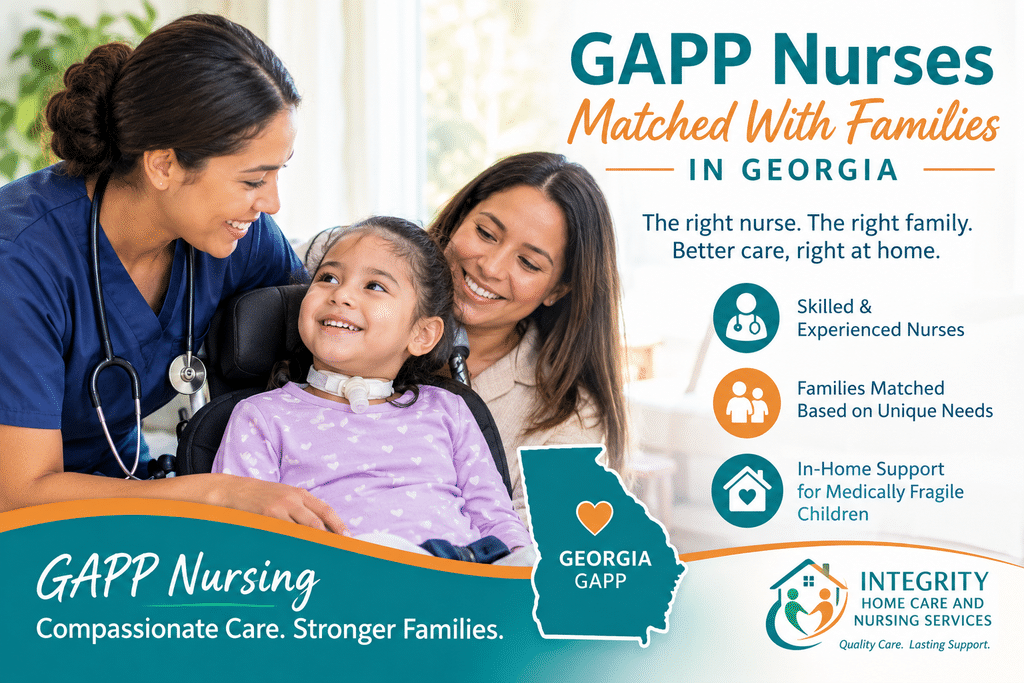
Finding the right nurse for a medically fragile child is an important step toward providing safe, consistent, and compassionate care at home. Through Georgia’s Pediatric Program (GAPP), eligible children may receive medically necessary in-home skilled nursing services based on their individual health needs. However, successful care involves more than meeting medical requirements. It also means finding a nurse who can work well with the child and family.
At Integrity Home Care and Nursing Services, we understand how important it is for families to feel comfortable and confident with their child’s care team. Our goal is to help families navigate the process of arranging appropriate pediatric nursing support while considering their child’s needs, care plan, and family circumstances.
What Is GAPP in Georgia?
The Georgia Pediatric Program (GAPP) is a Georgia Medicaid program that provides authorized in-home nursing services for eligible medically fragile children under 21. These services help children with qualifying medical conditions receive skilled nursing care in their home, when medically necessary and authorized.
Depending on the child’s needs and approved services, GAPP nursing may support children who require assistance with:
- Tracheostomy and ventilator care
- G-tube feeding and nutritional support
- Seizure monitoring and management
- Medication administration and health monitoring
- Respiratory support and other skilled nursing interventions
- Care related to complex neurological or genetic conditions
Each child has unique medical needs. Therefore, the nurse-family matching process should consider the child’s care requirements and the qualifications needed to provide the authorized services.
How Are GAPP Nurses Matched With Families?
Matching a GAPP nurse with a family involves several important considerations. The process may vary depending on the child’s medical needs, staffing availability, and the agency’s procedures.
1. Reviewing the Child’s Medical Needs
First, the care team reviews the child’s medical information, physician orders, and applicable care plan. This information helps identify the nursing skills and level of support the child requires.
For example, a child who needs tracheostomy care may require a nurse with relevant experience in airway management. Similarly, a child who receives G-tube feedings may need a nurse familiar with the child’s prescribed feeding routine and related care.
This step helps the agency identify nurses whose qualifications and experience align with the child’s authorized care needs.
2. Checking the Nurse’s Qualifications and Experience
Next, the agency considers the nurse’s credentials, experience, and ability to perform the required nursing duties.
Depending on the child’s care needs and applicable authorization, the agency may consider a Registered Nurse (RN) or Licensed Practical Nurse (LPN). The selected nurse must meet applicable licensing requirements and have the skills necessary to provide the assigned care within their scope of practice.
The goal is to support safe, appropriate, and consistent nursing care for every eligible child.
3. Considering the Family’s Schedule and Preferences
In-home nursing takes place in the family’s home, so scheduling and communication are important parts of the matching process.
The agency may discuss the family’s preferred schedule, requested nursing hours, household routines, and other practical considerations. It can then evaluate whether available nurses can meet those needs.
Families should communicate any important preferences early in the process. Although staffing availability may affect the options, clear communication can help the agency identify a suitable arrangement.
4. Evaluating Communication and Family Compatibility
A positive nurse-family relationship can make daily care more comfortable and manageable. Nurses work closely with children and caregivers, so respectful communication, professionalism, and an understanding of family routines are valuable.
Families should feel comfortable discussing their child’s care instructions, daily needs, and concerns with the nursing team. Likewise, nurses need clear information from caregivers to support continuity of care.
While personal compatibility matters, clinical qualifications, patient safety, and the child’s medical needs remain essential priorities.
5. Coordinating the Start of Care
Once an appropriate nursing arrangement is identified, the agency coordinates the necessary steps before services begin. These may include confirming the applicable authorization, reviewing the care plan, completing required documentation, and arranging scheduling and communication.
The agency must also ensure that the assigned nurse is qualified to provide the authorized services.
Because every child’s circumstances are different, the start of care depends on the required documentation, authorization, staffing availability, and other applicable requirements.
6. Maintaining Communication After Placement
Matching a nurse with a family is not necessarily the end of the process. Ongoing communication helps the family and agency address concerns, discuss changes in the child’s needs, and support consistent care.
Families should promptly communicate scheduling issues, questions about care, or concerns about the nursing arrangement to the appropriate agency representative.
If a placement is not meeting the child’s needs, the family can ask the agency to review the situation and discuss possible solutions. Any change in nursing arrangements remains subject to staffing availability, clinical requirements, and applicable authorization.
What Should Families Look for in a GAPP Nurse?
When discussing nursing placement with a GAPP provider, families can consider the following questions:
- Does the nurse have the appropriate license and qualifications?
- Does the nurse have experience with the child’s specific medical needs?
- Can the nurse follow the child’s care plan and authorized nursing tasks?
- Is the proposed schedule consistent with the family’s needs and available staffing?
- Can the nurse communicate respectfully with the child and caregivers?
- Does the agency provide a clear process for reporting concerns and requesting assistance?
These questions can help families understand their options and participate in the care-planning process.
What If a Family Needs a Different GAPP Nurse?
Sometimes, a family’s needs or circumstances change after nursing services begin. A schedule may no longer work, a child’s medical needs may change, or communication concerns may arise.
Families should contact their GAPP provider to discuss the concern. The agency can review the situation and explain the available options, which may include reassessing scheduling or exploring another qualified nurse when staffing permits.
Families should also notify the appropriate care team about significant changes in the child’s medical condition so the care plan can be reviewed as needed.
How Integrity Home Care and Nursing Services Supports Families
At Integrity Home Care and Nursing Services, we recognize that every medically fragile child deserves individualized attention and appropriate nursing support.
Our team works to help families understand the in-home pediatric nursing process, coordinate care requirements, and explore available nursing arrangements based on each child’s needs and staffing availability.
We understand that parents and caregivers need clear communication throughout the process. Our goal is to help families feel informed as they navigate GAPP services and work toward a nursing arrangement that supports their child’s well-being.
Eligibility, covered services, nursing hours, and authorization depend on applicable Georgia Medicaid requirements and the child’s individual circumstances.
Get Help With GAPP Pediatric Nursing in Georgia
Are you looking for in-home nursing support for your medically fragile child? Integrity Home Care and Nursing Services can help you learn more about GAPP and the steps involved in arranging pediatric nursing care.
Contact Integrity Home Care and Nursing Services today.
- Phone: 678-907-3454
- Website: https://integrityhomecareandnursing.com/
Let us help you explore available options for compassionate, individualized in-home nursing support for your child.
Disclaimer: GAPP eligibility, service authorization, and nursing availability are subject to applicable Georgia Medicaid requirements. Contact the agency to discuss your family’s circumstances and available services.